

brings unprecedented purity
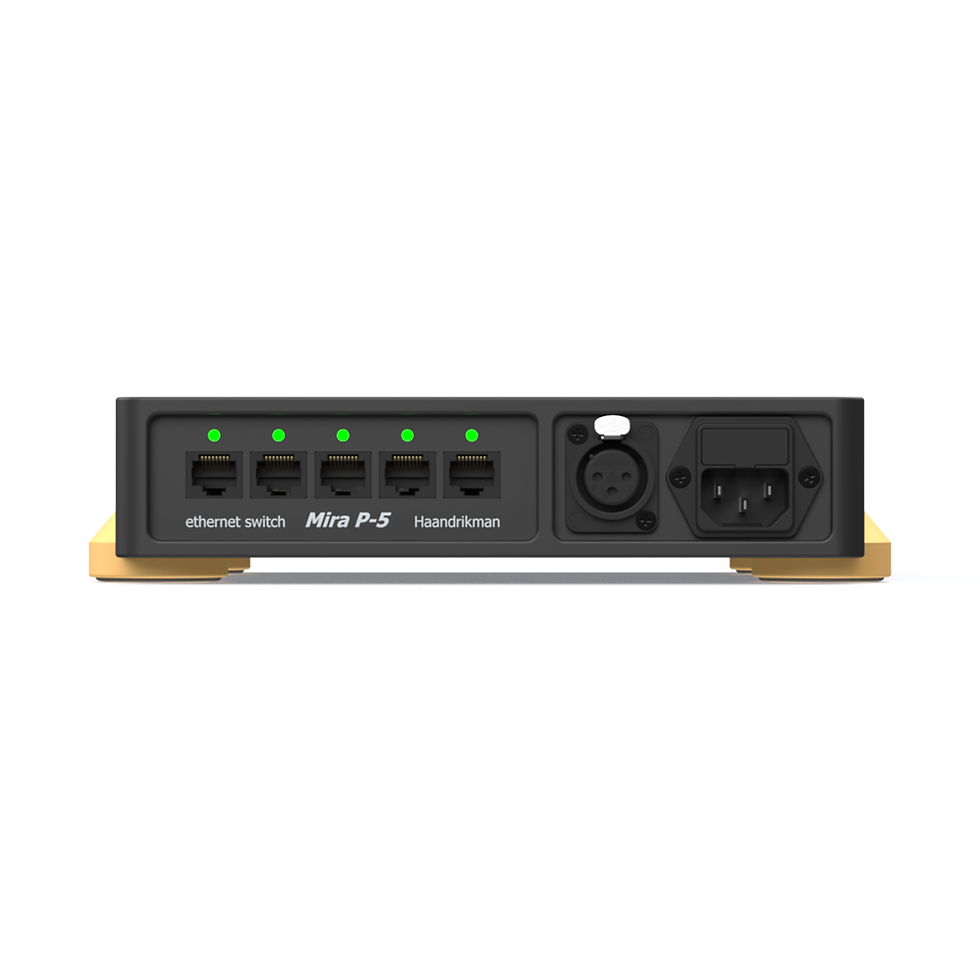
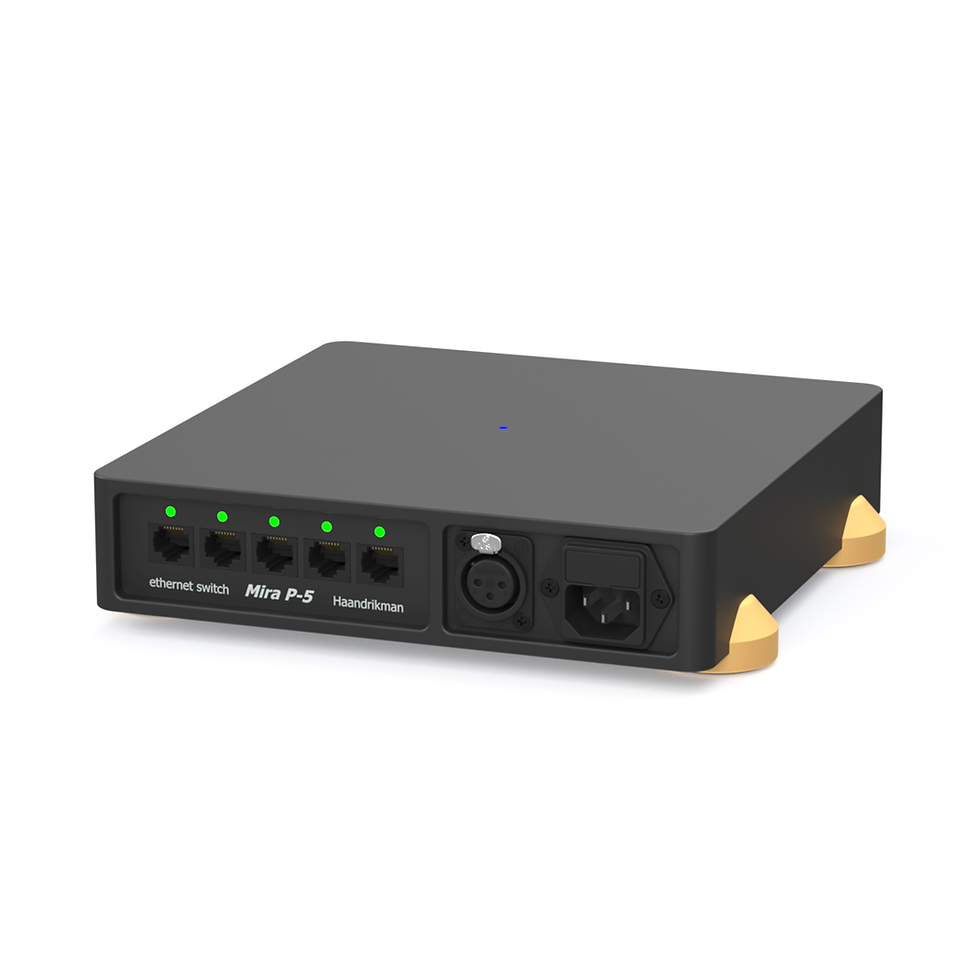
The Mira P-5 ethernet switch
Mira P-5 ethernet switch
In the world of high-end audio, every component matters. The network switch, often overlooked, is the gateway through which your digital stream must pass. The most critical disturbances for an audiophile network switch are Clock Jitter, Power Supply Noise (mains noise/EMI), and leakage currents.
Addressing these disturbances is essential because they are passed on via the Ethernet cable to connected audio components, such as streamers or network players. The Mira P-5 is engineered to eliminate these digital pollutants, delivering a signal that is fundamentally cleaner, more stable, and truer to the original recording. For optimal performance, connection to Sygnus X-2 power processors is highly recommended to establish a foundation of clean power and Earth.
Essential features
Low-Jitter Master Clock
Ultra Low-Jitter Clock, resulting in sharper transient attacks, greater micro-detail, and the ability to hear subtle textures and reverb tails that were previously masked by timing noise..
Ultra-Stable Power Supply
Ultra-stable linear power supply with a two-stage-regulator and extremely low noise. This design removes subtle electronic hash and ripple that would otherwise leak into the signal, resulting in a perceptibly "blacker" background. This reveals more micro-detail and delivers greater clarity. The high stability ensures that all circuits receive steady, instantaneous current, resulting in superior control and transient accuracy, particularly in the low frequencies. Consequently, bass notes become tighter and more defined. Furthermore, the low noise reduces distortion of the signal’s harmonic structure, resulting in a richer, more organic sound, removing the "hard" or "etched" quality often associated with digital noise..
Dedicated Earth System
The Mira P-5 is a double-insulated device, utilizing the Protective Earth (PE) solely as a Functional Earth (FE). This system provides a facility to bypass noise and interference present on the standard Mains Earth via a dedicated XLR connection. When the XLR Dedicated Earth Plug is connected, the internal system automatically isolates the Functional Earth derived from the mains, ensuring the unit only references the ultra-stable, clean earth supplied by the Sygnus connection. This eliminates earth-loop interference, resulting in an absolute silence against which the music is played. The purity of the earth reference ensures that the internal clock and digital engine operate with maximal precision, resulting in superior focus and image definition.
1500V Port-to-Port Isolation
The Ethernet cable inevitably acts as a conduit for electrical noise generated by connected components. This essential isolation barrier physically separates the electrical domain of all five ports, virtually eliminating noise cross-contamination. The audible result is a significant improvement in spatial definition and clarity, allowing the soundstage to open up dramatically and maximizing the transparency of the entire playback chain.
Audio-Optimized Data Rate
The Mira P-5 is intentionally designed with a 10/100Mbps data rate. Unlike standard Gigabit (1Gbps) switches designed for mass data transfer, the Mira P-5 prioritizes signal purity. High-speed networking components generate significantly higher levels of high-frequency noise and processing overhead, which can induce jitter and pollute the sensitive circuitry of your streamer. Since even the highest-resolution audio streams require only a fraction of this bandwidth, our 100Mbps architecture ensures a significantly lower noise floor and a more stable environment, preserving the delicate nuances of your music.


Optimizing performance
The Mira P-5 performs best when paired with an additional Ethernet isolator, a clean Earth connection, and a clean power source. The Sygnus X-2 provides all these features. Refer to the connection diagram below for optimal performance.
Connecting to the Sygnus X-2
There are three common ways to connect the Sygnus X-2 to your audio system. The images below show these setups.

Specifications
Electrical characteristics
Network
General
Why Digital Integrity Matter
In high-fidelity streaming, there is a common misconception that "bits are bits." While the network ensures the data (the 1s and 0s) arrives intact, it does not guarantee the timing integrity or the electrical silence of the environment in which that data is processed. To understand why a network switch affects the sound of your streamer or DAC, we must look at the intersection of high-frequency digital data and sensitive analog circuitry.
Jitter and Pulse Deformation
Jitter is the deviation in the timing of digital pulses. In a standard network switch, the internal clock is often a low-cost oscillator. This lack of precision causes the duration of a "1" to be slightly longer or shorter than a "0", a phenomenon known as duty cycle distortion.
While your streamer’s buffer ensures the data is correct, the irregular timing of these incoming pulses creates a "choppy" electrical environment. This forces the streamer's internal processing to work harder, creating a ripple effect that can interfere with the precision of the DAC's conversion clock.
From Digital Timing to Common-Mode Noise
The timing errors (jitter) and the rapid switching inside a standard switch do not stay confined to the digital domain. They manifest as Common-Mode Noise.
This is high-frequency electrical noise that exists on all conductors of an Ethernet cable simultaneously. Because this noise is directly correlated with the activity of the network clock, it isn't "random" noise; it is a form of interference that hitches a ride on the data signal and penetrates your audio equipment.
The Impact of Power Supply Noise
The power supply of a switch plays a critical role. Most standard switches use cheap Switch Mode Power Supplies (SMPS) that inject high-frequency noise into the circuit.
-
Signal Corruption
This noise "rides" on the voltage levels of the digital signal. Instead of a clean voltage plateau for a "1", the signal becomes "fuzzy" or raked with interference.
-
Leakage
This noise travels through the Ethernet cable and can bypass standard isolation transformers via parasitic capacitance, eventually reaching your streamer's sensitive internal components.
Galvanic Isolation: The Final Barrier
Even with a high-precision clock and a clean power supply, a physical copper connection can act as a bridge for interference. This is where Galvanic Isolation becomes essential. It is the principle of isolating functional sections of electrical systems to prevent stray currents and noise from flowing between them.
-
Breaking the Ground Loop
It ensures that the electrical "garbage" from your router or noisy home peripherals stays far away from your audio system’s signal ground.
-
Filtering Leakage
Specialized isolation ensures that only the data signal passes through, while the high-frequency common-mode noise is physically blocked from entering your streamer.
The Result: Restoring the Analog Noise Floor
When jitter, power noise, and common-mode interference infiltrate your DAC, they raise the analog noise floor. While you may not hear a 'hum,' this noise masks the subtlest signals: the delicate decay of a piano note, the texture of a singer’s breath, and the acoustic 'air' of the recording space.
By focusing on clock stability, power purity, and galvanic isolation, we treat the network switch as a true audio component. As the noise floor drops, the 'digital edge' vanishes, restoring a 'black background' that allows the finest micro-details of the performance to emerge.
Frequenly Asked Questions
If my streamer is "bit-perfect," how can a network switch like the Mira P-5 change the sound?
"Bit-perfect" only ensures that the data packages are correct. However, digital audio is transmitted as a physical electrical signal. Standard switches introduce clock jitter and high-frequency common-mode noise. These "digital pollutants" travel via the Ethernet cable into your streamer, raising the analog noise floor and masking micro-details. The Mira P-5 is engineered to eliminate these disturbances at the source, ensuring superior Digital Integrity.
Why does the Mira P-5 use a 10/100Mbps data rate instead of Gigabit?
This is a deliberate design choice. Gigabit components require high-speed processing that generates significantly more high-frequency noise and EMI, which induces jitter. Since even high-resolution audio streams require only a fraction of 100Mbps, the Mira P-5's architecture ensures a much lower noise floor and a more stable environment for your sensitive audio circuitry.
How do the Sygnus power processors enhance the performance of the Mira P-5?
The Mira P-5 performs best when its grounding and power environment are fully optimized. Both the Sygnus X-1 and X-2 act as the central foundation for your system, providing a Dedicated System Earth and clean 230VAC. By connecting the Mira’s dedicated ground input to a Sygnus, the switch automatically decouples from the noisy mains earth (PE) and uses the Sygnus’s "Clean Earth" to drain away common-mode noise.
What is the difference between using the Mira P-5 with a Sygnus X-1 versus an X-2?
The choice depends on the level of isolation you require:
-
With Sygnus X-1: You get the essential foundation of clean AC power and the central dedicated earth point. This significantly improves the Mira's performance by draining away ground-plane noise.
-
With Sygnus X-2: This is the ultimate "Isolated Island" setup. In addition to the features of the X-1, the X-2 adds an Active Earth Conditioner (AEC) for even deeper ground cleaning and an integrated Network Isolator. This allows you to block noise from your internet source (router/modem) before it even reaches the Mira switch, providing total decoupling of the data path.
Can I use the Mira P-5 without a Sygnus processor?
Yes. The Mira P-5 is a standalone high-end component featuring an internal ultra-stable linear power supply and a low-jitter master clock. It will provide a substantial upgrade over any standard switch. However, the Sygnus line is designed to remove the external electrical barriers that prevent the Mira from reaching its absolute maximum potential.
What are the audible benefits of this integrated approach?
Listeners typically describe the experience as "removing a veil." You will notice a significantly blacker background, sharper transient attacks, and a more precisely defined soundstage. By resolving timing errors and lowering the noise floor, the music loses its "digital glare" and gains the natural, fluid texture of an analog performance.